In honor of Women's History Month this month, we are celebrating the remarkable women at Forge. This year we are featuring interviews with four new women in leadership roles across four different departments at Forge. Corina Escobar, Aga Gascoyne, Alicia Doyle, and Julie Bartz all sat down with Jess Bender to share their journey, what success looks like to them, what leadership means to them, and so much more. Join us as we share their stories, explore their work at Forge, and learn about the people who inspire them.
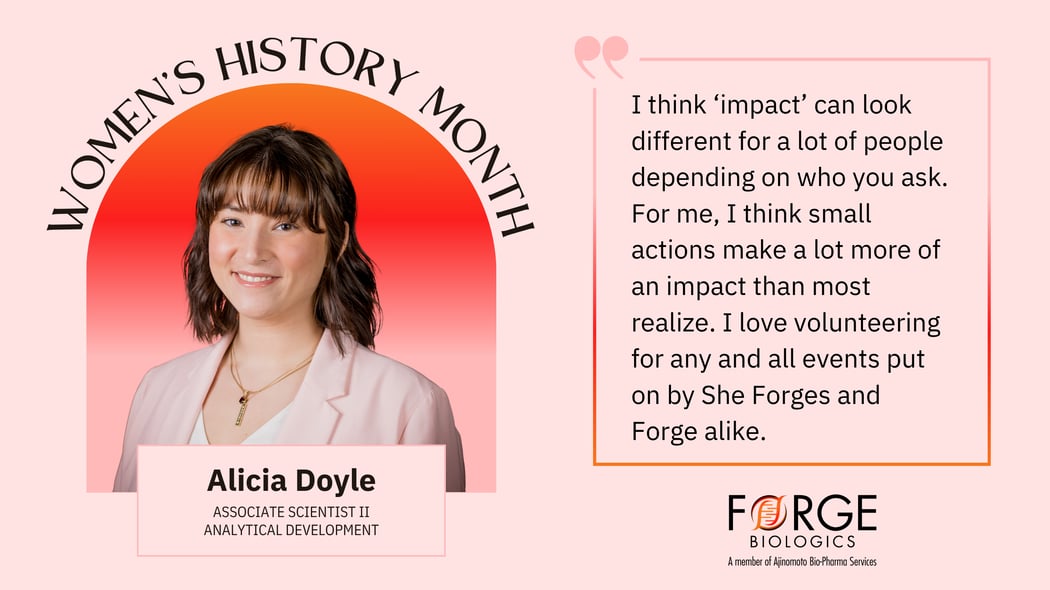
Meet Alicia Doyle, Associate Scientist II, Analytical Development
Alicia earned her bachelor's degree in Biochemistry from the University of Akron and her master’s in public health from The Ohio State University. Alicia began her journey in gene therapy back in 2019 at Nationwide Children’s Hospital (NCH). She worked alongside fellow Forgers Darren Murrey and Megan Berger in her previous lab at NCH. Overall, Alicia is approaching 7 years total working in gene therapy! Her first day at Forge Biologics happened to fall on her birthday in 2022, but she says working at Forge has been the best gift. She hopes to apply what she learned about good leadership in her master’s program to grow in her career.
Alicia is married to her husband, Mason, and is the mother of three cats, Henry (10), Bear (8), Arya (3), and dog Charlie (1 1/2). She and her husband are annual passholders to Universal Orlando and frequent the parks at least three times a year. In her free time, Alicia loves planning trips to Universal (for herself and others), planning birthday parties and family get togethers, reading too many books, and starting new projects but rarely finishing them.
What does “impact” look like to you in your role, beyond your job title?
I think “impact” can look different for a lot of people depending on who you ask. For me, I think small actions make a lot more of an impact than most realize. I love volunteering for any and all events put on by She Forges and Forge alike. Visiting all the elementary schools in central Ohio to inspire younger generations to become scientists like me one day, keep me going. The strawberry experiment we introduce to kids is the same one that made me committed to my future of being a scientist one day. For something that takes 15-20 minutes and might not seem significant, it changed my entire trajectory in life. Other events like helping prep for the next set of campers at Flying Horse Farms feels like I am being rewarded way past just helping others. The fresh air cannot be beaten, but the lasting impact of volunteering ensures that this camp can continue to provide amazing opportunities for children.
How has your definition of success changed throughout your career?
As a child, I thought success meant having a house of my own, a car, maybe a few cats and a dog, and most importantly, being a scientist. I can say with certainty that little Alicia would look at me in awe of what I have achieved. I’ve checked all the boxes off the list required to make me “successful.” I think throughout my career, my thoughts on what makes me successful have always changed, and that’s the beauty in it. One thing is for certain though, and that’s always looking back on where I came from. One of my favorite memories from 2019 was when my husband, Mason, and I visited my uncle in California. We had made it a daily mission to climb one mountain (or sometimes a really big hill) a day. Due to my clumsiness, I spent most of the trek looking down at my feet to make sure I didn’t trip or stumble. That very first mountain peak, Mason and I were looking at the beautiful view, I turned to ask why my uncle was facing back towards the path we had just come from. He looked at me and said, “The most important thing you should do when you achieve something great, is to look back and see just how far you’ve come.” From that day on, I’ve used this as my mantra, my outlook on life and success, and how to be grateful for all the stumbles along the way that brought me to where I am today. Success to me now is acknowledging everything I’ve accomplished and feel proud to say “I did that!” and looking forward to all that I can achieve.
Who has played a meaningful role in your professional growth, and how did they support you?
My current manager, Mikhail Gavrilin , has played a huge role in my professional growth. Mikhail’s unending support of both me and my peers to never stop growing and improving ourselves is one of the best traits I am grateful for in a manager (and for allowing a flexible schedule to make it possible to finish my master’s!). My colleagues, Claudia Kelly and Julia Zalewski, both played a huge role getting me out of my shell enough to even apply for a master’s program. Without those two, I wouldn’t have even considered myself capable of being accepted into the program. Their encouragement and study sessions helped keep me afloat when I was learning to get my going-back-to-school sea legs. Special shoutout to those two who are graduating this spring! It really does take a village sometimes to achieve the things we think are just out of reach, and I am forever grateful to everyone who made it possible.
How do you reset when things feel overwhelming?
When everything gets to be too much, I like to reset by sitting down with a good romance novel (I’ve read 23 so far this year), playing what seems like endless tug-of-war with my dog Charlie, planting and maintaining my garden, trying out a new baking recipe, or even planning my next trip to Universal Orlando with my husband, Mason. Controlling the things I can and letting go of the things I cannot is always a good reminder to myself when things get to be overwhelming.
I think therapy is one of those things that people often think they are too good for (hi, that’s me six years ago). When things get overwhelming, and my usual comfort resets are just not working the way they usually do, I will set up an appointment with my therapist to get a new perspective on things. I’m a big fan of therapy, especially EMDR, and it’s one of the things that I think has helped most with keeping my head above water when things get overwhelming (like going back to school while working full time). Do yourself a favor, and don’t be too stubborn to ask for help when it’s needed!
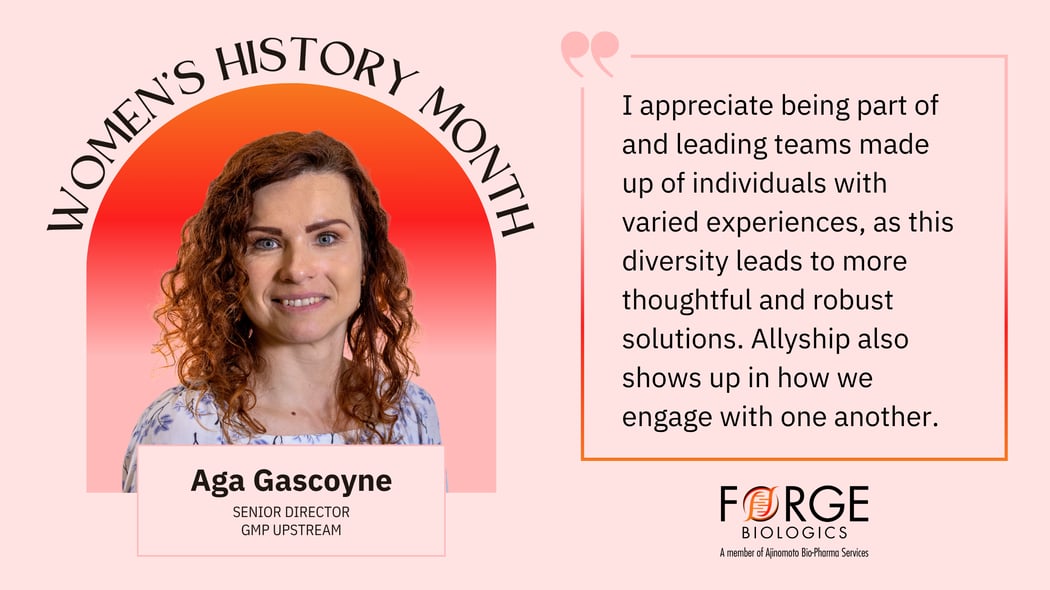
Meet Aga Gascoyne, Senior Director GMP Manufacturing - Upstream
Aga holds a master’s degree in Biotechnology/Molecular Biology and a Ph.D. in Biochemistry from Jagiellonian University in Poland. After several years in academia, she transitioned to industry, working at VWR Chemicals before joining Abeona Therapeutics, where she developed a strong passion for cell and gene therapy. In 2022, she joined Forge to continue contributing to the development of life-saving gene therapies. Overall, she brings more than 12 years of cGMP experience, including the last 8 years focused on cell and gene therapy.
Aga is married to her husband, Jacques, and is a mother to two children, Kallista (14) and Sebastian (10). On weekends, she often travels out of state to support her daughter at cheer competitions. When she’s not at competitions, she enjoys gardening and working on home improvement projects. She also likes practicing yoga, reading, and spending time with her family and friends. A lifelong learner, Aga is always looking for opportunities to learn something new and foster personal growth.
What’s a skill or strength you’ve developed over time that you didn’t realize would be so important?
Two skills I’ve developed/improved over time that have become so critical are resilience and perseverance. Both are essential in leadership and become even more important as you move into more senior roles.
Resilience allows you to operate effectively under pressure and make decisions even when you don’t have all the information available. Leaders often need to make decisions that involve some risk and, at times, take educated guesses to keep the organization moving forward toward its goals.
Perseverance is equally important when driving positive changes. Improving how an organization operates requires persistence, a solutions-focused mindset, and the ability to keep moving forward despite obstacles.
How has your definition of success changed throughout your career?
I’m grateful to be part of an organization that improves patients’ lives, especially given how closely our cGMP work at Forge connects my team and me to the therapies we produce. Making a positive impact on patients’ lives and well-being is the ultimate measure of success.
Early in my career, success meant contributing individually to team and company outcomes. As I transitioned into leadership, my impact expanded through the performance and growth of my team—their success became my success. Over time, my perspective has continued to broaden, with an increased focus on driving company-wide impact.
What does allyship or support look like to you in a workplace setting?
Allyship in the workplace, to me, means fostering a strong sense of belonging where everyone feels they are part of a team working toward a shared goal. It’s about valuing diverse perspectives and recognizing that differences in opinions or backgrounds strengthen our ability to solve problems and drive better outcomes.
I appreciate being part of and leading teams made up of individuals with varied experiences, as this diversity leads to more thoughtful and robust solutions. Allyship also shows up in how we engage with one another: approaching discussions with openness, respect, and a solution-oriented mindset. When we collaborate cross-functionally with that mindset, it creates an energizing environment where we can move quickly, accomplish more, and make meaningful progress together.
What does leadership mean to you, regardless of title?
Leadership, to me, is about helping others be their best, motivating and inspiring them while encouraging personal and professional growth. It means setting clear goals, creating a path to achieve them, and bringing others along on that journey. It’s also about sharing success and supporting others so they can succeed as well.
I try to instill the same mindset in my kids, encouraging them to be that kind of leader at school, with their friends, and on their sports teams.
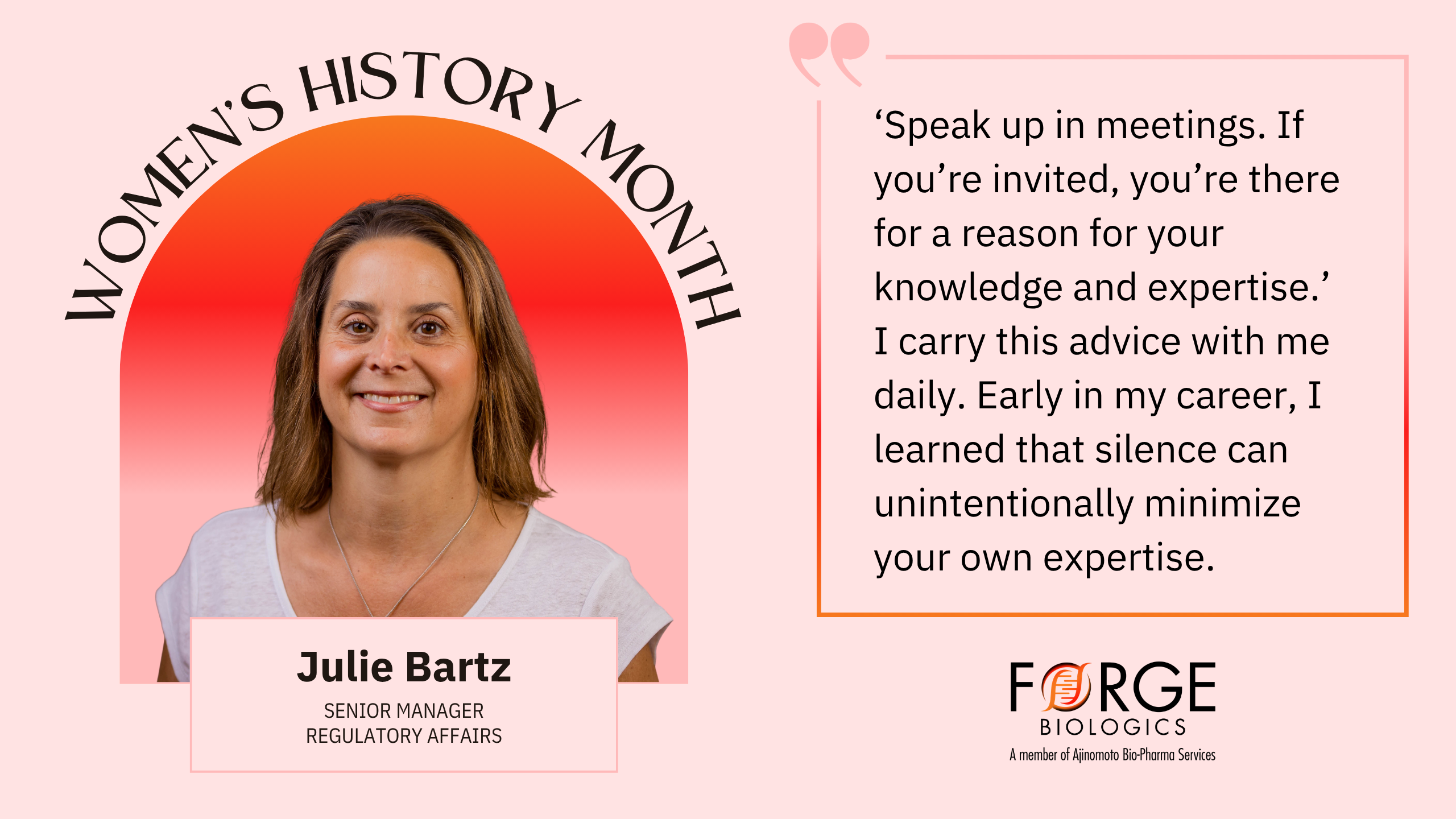
Meet Julie Bartz, Senior Manager Regulatory Affairs
A proud Columbus native (Clintonville!) where she lives with her husband and cat (Bert). Julie is a graduate of Bishop Watterson High School and The Ohio State University.
Prior to joining Forge, Julie worked for Nationwide Children’s Hospital at the Center for Gene Therapy on the MPS IIIB program for eight years, contributing to meaningful advancements in rare disease research. She then spent nine years at Battelle developing and qualifying assays for clinical and non-clinical studies—work requiring precision, persistence, and a deep commitment to scientific integrity.
Julie recently celebrated five years at Forge (starting in October 2020). She began in Analytical Development before transitioning to the CMC side of Regulatory Affairs, where she now manages Forge’s Drug Master File and supports client regulatory submissions. Blending technical expertise with persuasive, strategic communication, she thrives at the intersection of science and storytelling. She also recently completed a Medical Writing and Editing Master’s Certificate from University of Chicago, further sharpening her ability to translate complex science into clear, impactful language.
What is the best leadership or professional advice you have ever received?
“Speak up in meetings. If you’re invited, you’re there for a reason for your knowledge and expertise.”
I carry this advice with me daily. Early in my career, I learned that silence can unintentionally minimize your own expertise. Over time, I have realized that contributing thoughtfully doesn’t just elevate my own voice; it strengthens the entire team.
For women especially, I believe this reminder is powerful: your seat at the table is not accidental. Own it.
What do you do or value outside of work that contributes to what you do when you are at work?
After graduation, I spent several years traveling across the western half of the United States doing environmental fieldwork, which I would describe as “getting paid to backpack and fish.” That season of life sparked a lifelong love of the outdoors. Time outside is restorative and grounding for me whether its hiking, paddling, camping, or gardening, it reconnects me to simplicity and patience—qualities that directly support my professional focus and resilience. Tending a garden requires consistency and care, much like long-term scientific or regulatory work.
Cooking is another creative outlet. Preparing nourishing meals from scratch, especially comfort foods from childhood, reinforces intentionality and balance. There’s something deeply satisfying about slowing down, following a process, and creating something meaningful. That same mindset carries into my professional life: thoughtful preparation, attention to detail, and pride in the finished product. I especially love to prepare nostalgic meals from my childhood like beef stroganoff and spatzle.
My favorite quote that connection me to the outdoors:
“Into the forest I go, to lose my mind and find my soul.” — John Muir
Have you read any great books recently that have impacted your personal or professional life?
I was impacted by How Women Rise: Break the 12 Habits Holding You Back from Your Next Raise, Promotion, or Job by Marshall Goldsmith and Sally Helgesen.
The book outlines common habits that can unintentionally limit women’s professional growth such as overvaluing expertise, reluctance to claim achievements, or striving for perfection. What resonated most with me was the practical framework for recognizing and addressing these behaviors. The takeaway isn’t about changing who you are, it’s about being aware of patterns and intentionally choosing growth.
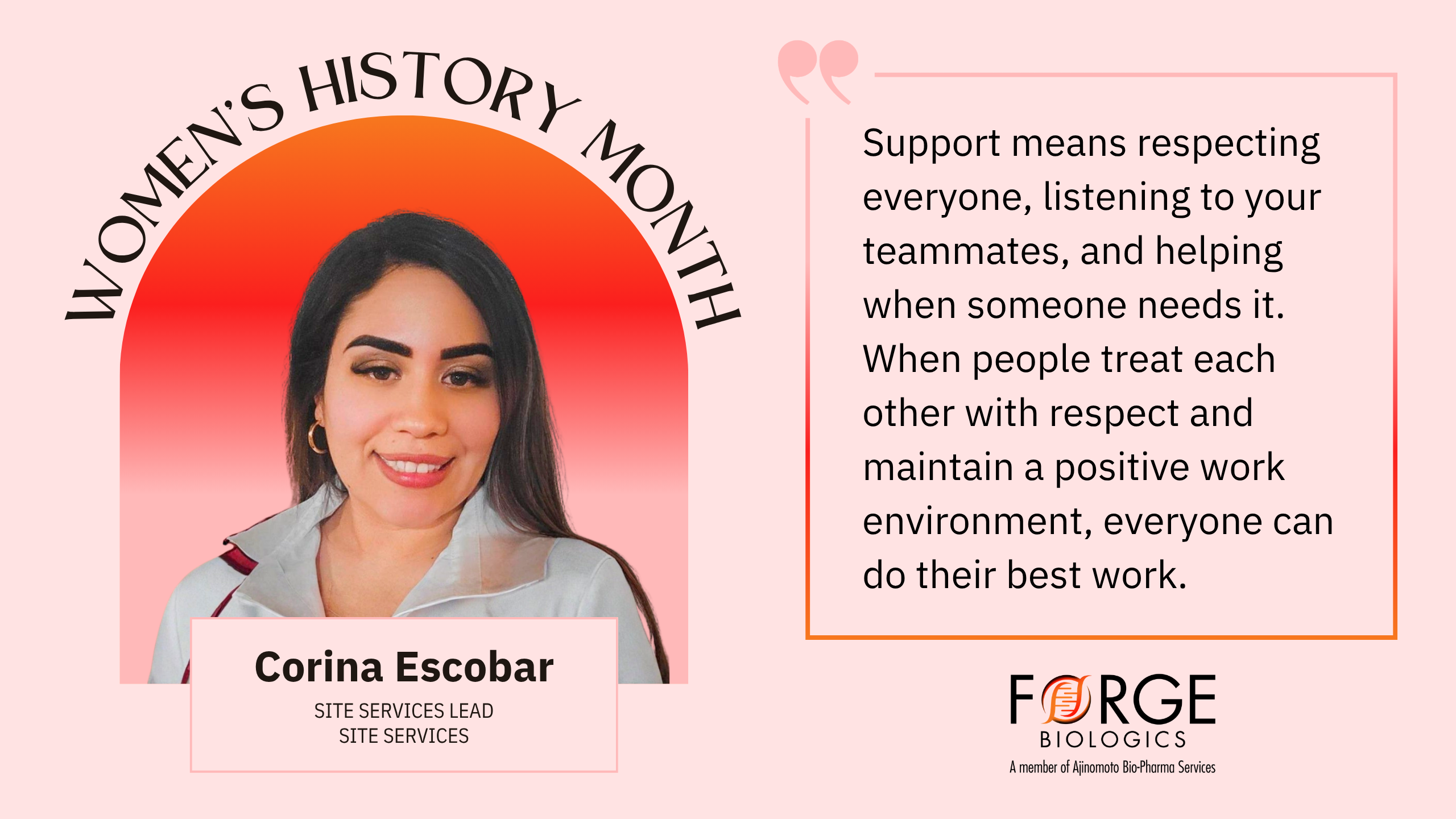
Meet Corina Escobar, Site Services Lead
Corina recently celebrated five years at Forge, growing within the Site Services team to her current role as Lead. Originally from Washington State, Corina is proud of her Hispanic heritage and family roots in Mexico City.
Family plays a central role in her life. She and her husband are raising three children: Ashley (13), Austin (10), and Dalezya (3), who motivate her every day to work hard and continue growing.
During her time at Forge, Corina has embraced opportunities to develop in her role, support her team, and contribute to the company’s success. For her, leadership isn’t just about the work being done; it’s about supporting others, setting the standard, and helping the team succeed together.
I had the privilege of sitting down with Corina to learn more about her journey, leadership perspective, and what it means to grow as a working woman at Forge.
What moment in your career most shaped how you show up at work today?
Becoming a Lead really changed my perspective. I realized the role wasn’t just about cleaning anymore; it was about supporting my team, setting standards, and helping solve problems. It helped me understand the responsibility of guiding others and making sure everyone can do their best work. I have learned that the keys to success are communication and teamwork. As a leader, it’s important to listen to your team, address issues early, and keep people motivated and productive.
How has your definition of success changed throughout your career?
Family is very important to me. Earlier in my career, I sometimes prioritized work too much and learned the hard way that balance matters. Now I understand that success means taking care of your family while also doing work you love. I’m grateful that at Forge I feel empowered to take that time when my family needs me.
What does support in the workplace look like to you?
Support means respecting everyone, listening to your teammates, and helping when someone needs it. When people treat each other with respect and maintain a positive work environment, everyone can do their best work.
What is something organizations can do to better support women?
Women can do anything as long as they have the support, structure, and tools to succeed. Creating an environment where people feel respected and supported makes a big difference.
How do you stay motivated during challenging times at work?
Keeping a positive mindset is important. When I encounter challenges, I try to step back, process the situation, and then take action. Maintaining positive energy helps me and my team stay focused.
What advice would you give someone earlier in their career?
Always ask questions and keep learning. Learning from others helps you grow professionally and become more confident in your role.
I would also encourage people to speak up and have conversations when something needs to be addressed. That’s how we improve and support each other.
What does “Moving Forward Together” mean to you?
To me, it means working as a team, supporting one another, and continuing to build a positive environment where everyone can succeed.